




Business memory
Who you are • What you sell
Keeps you in the room
AI should learn your business before it runs your business.
Foundrly develops an understanding of your customers, workflows, preferences, priorities and business activity so it can help you decide what matters, prepare the work and act when you're ready.
THE BUSINESS
Who you are • What you sell
Who matters • How relationships evolve
How work gets done

FOUNDRLY
Systems provide the information. Foundrly builds the understanding around it.
How you like things handled
What happened before • What was decided
What is happening now
Who you are • What you sell
Who matters • How relationships evolve
How work gets done
How you like things handled
What happened before • What was decided
What is happening now
Understand
We make sense of all your data
Recommend
We surface what matters most
Draft
We prepare the right actions for you
Approve
You review and confirm
Act
We help you get it done
The category
An AI business assistant is software that helps an owner find information, understand what is happening in the business, prepare communications, identify priorities, coordinate work, handle repetitive tasks and support decisions, ideally across the systems the business already uses rather than in isolation.
Most AI software for small business today works as a place to ask questions. You open it, explain your situation, get a useful answer and close it. That is genuinely helpful. It is also where most of the effort goes, because you supply the context every single time: your customers, your services, your pricing, your standards, and what you decided last month.
The more valuable opportunity is an AI assistant that becomes increasingly specific to the business it serves.
Foundrly is being built around persistent business context rather than a series of independent one-off interactions. The aim is that an AI assistant for small business should get more useful the longer it works with you, because its understanding of how your particular business operates keeps accumulating.
The context problem
Your business already knows all of this.Your AI should too.
From data to understanding
Sarah is a customer.
Sarah has spent $640.
Sarah normally returns every six weeks.
Sarah left a five-star review.
Sarah prefers appointment reminders by email.
The intelligence underneath
The progression
“What happened?”
Foundrly retrieves the relevant information.
“Why does this matter?”
Foundrly connects the event to business context.
“What should we do next?”
Foundrly suggests an action.
“Get it ready.”
Foundrly drafts or coordinates the work.
“Go ahead.”
Foundrly executes within the boundaries you approved.
The goal isn't more answers.
It's better decisions with less operational friction.
Keeps you in the room
Autonomy is set per workflow, and it moves in both directions. You can raise it where Foundrly has proven itself and lower it anywhere you want a closer look.
Level 1
Foundrly watches approved signals and surfaces insights.
Nothing happens.
Level 2
Foundrly prepares the work.
You edit and decide.
Level 3
Foundrly recommends and queues actions.
You approve before execution.
Level 4
Trusted recurring workflows can operate automatically.
You stay informed and can intervene.
Autonomy is earned, not assumed.
Decision history
Foundrly drafts a formal review response. You make it warmer.
Foundrly uses the warmer tone. You approve it unchanged.
Foundrly notices that similar responses perform well.
A similar situation appears. Foundrly recommends the proven approach.
Across the stack


 LIVE NOWNEXTLATER
ONE BUSINESS. ONE EVOLVING CONTEXT.
Start small. Learn deeply.
The long-term vision spans the whole business. Foundrly currently starts by helping local businesses with the operating signals that are visible and measurable from day one, which is also where the learning begins.
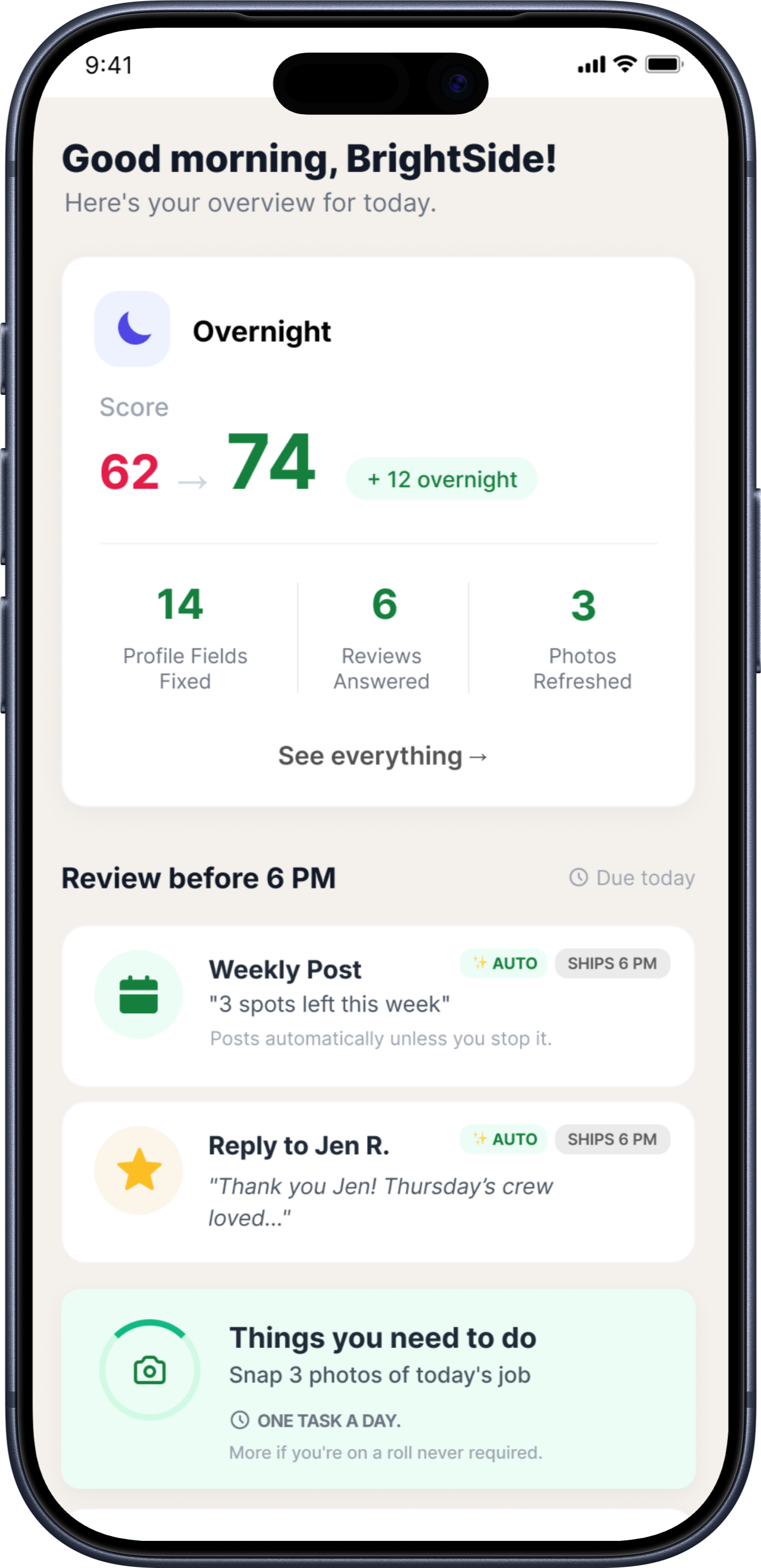
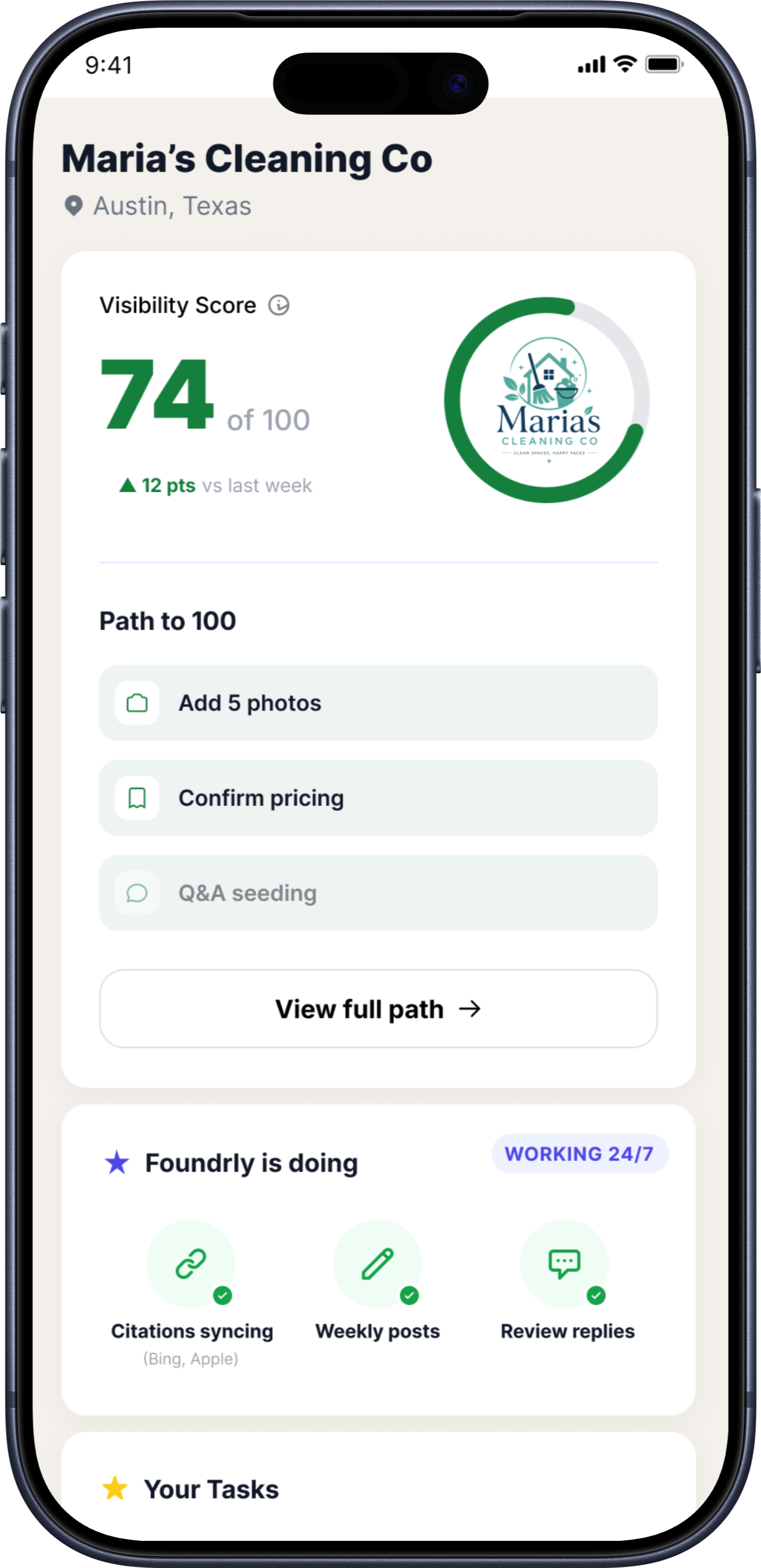
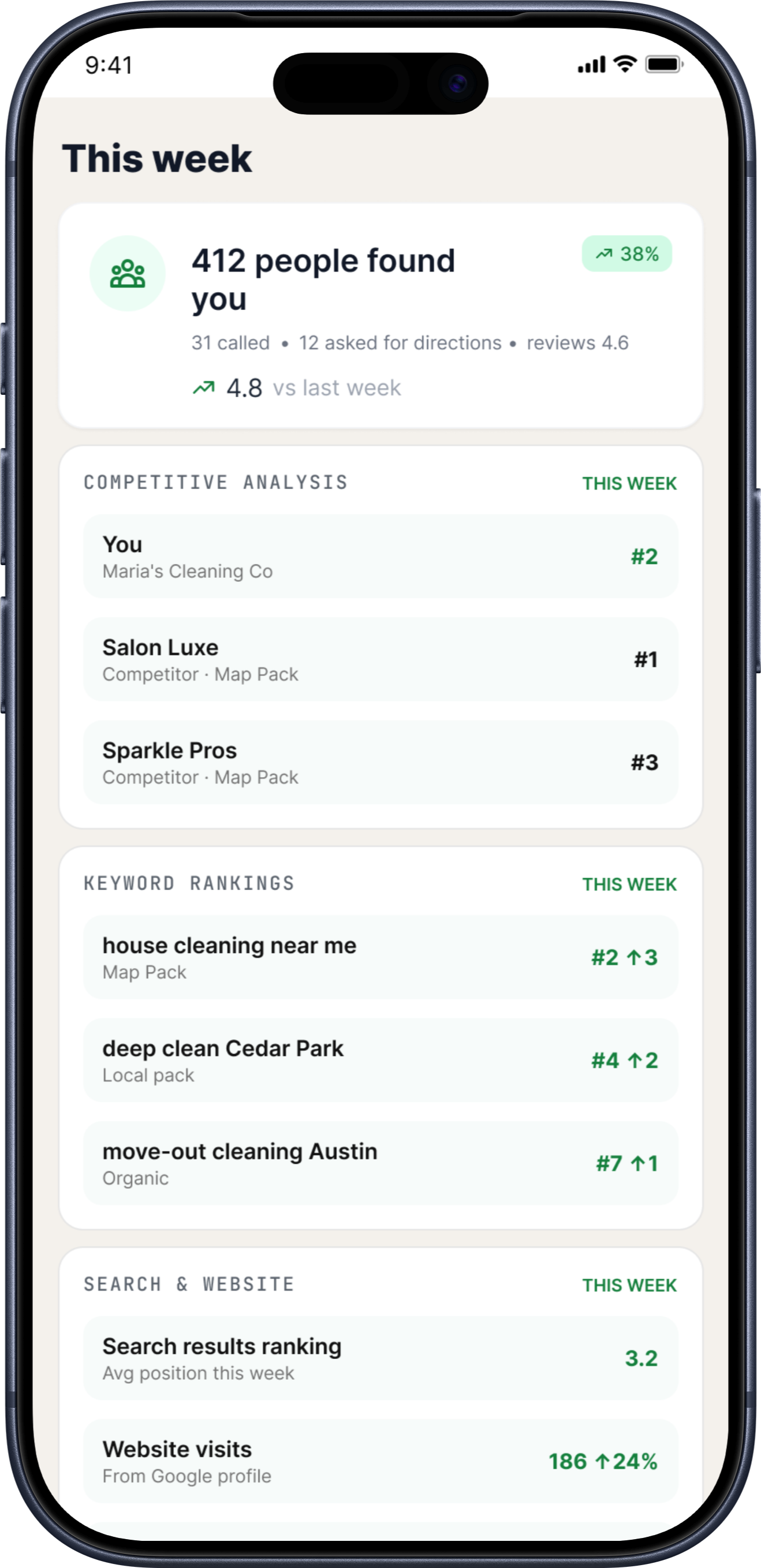
Visibility is the starting signal.
Business understanding is the destination.
Over time
Day 1
Who you are · What you sell · Your brand · Your business presence
Month 1
Your preferences · Your recurring work · Your reputation patterns · Your priorities
Deeper connections
Customer relationships · Workflow patterns · Operational context · Decision history
The vision
An AI co-founder that grows with the business.
Not because it knows everything on day one, but because its understanding compounds through real work.
The difference
Built for
Generic AI tools · General reasoning & assistance
Role-specific AI agents · A particular role or workflow
Foundrly Vision · The entire business
Context
Generic AI tools · User provides context
Role-specific AI agents · Connected to selected systems
Foundrly Vision · Builds business-wide context over time
Connections
Generic AI tools · Usually starts with the conversation
Role-specific AI agents · Connects to specific tools & data
Foundrly Vision · Connects information across functions
How it works
Generic AI tools · Responds to the request
Role-specific AI agents · Executes predefined responsibilities
Foundrly Vision · Understands, detects & supports decisions
Learning
Generic AI tools · Conversation-based
Role-specific AI agents · Role/workflow-based
Foundrly Vision · Learns owner preferences & recurring decisions
Scope
Generic AI tools · Individual task
Role-specific AI agents · Specific function
Foundrly Vision · Business-wide
Autonomy
Generic AI tools · User-driven
Role-specific AI agents · Task-driven
Foundrly Vision · Gradually earns autonomy
Generic AI tools
 ChatGPT
 Claude
 Gemini
Role-specific AI agents
 Harvey
 Sierra
 Agentforce
Foundrly Vision
The distinction is business-wide persistent understanding. Plenty of AI tools have memory, context, and integrations. The question is whether that understanding spans the whole business and keeps developing.
Architecture
AI agents for small business can perform specific jobs: responding to customer inquiries, monitoring reputation, preparing content, following up with leads, coordinating appointments. The Foundrly vision is that these should not operate as isolated agents, each rediscovering your business from scratch. They should share one understanding of the business, the customer, your priorities, the history, the rules and the current situation.
Shared Business Cognition
These named agents describe an architectural direction, not shipped products.
Trust and control
Foundrly only sees the systems you decide to connect. Nothing is assumed, and you can disconnect a system at any point.
What Foundrly can read, and what it can act on, are separate decisions. Connecting a system does not automatically grant it the ability to do anything.
Approval requirements are set per workflow using the control levels above, and you can change them whenever you want.
The understanding Foundrly builds about your business exists to make Foundrly more useful for your business.
Full details are in our privacy policy and security overview.
Questions
Software that helps a business owner find information, understand what is happening, prepare communications, identify priorities and handle repetitive work, ideally across the tools the business already uses rather than as a separate place to go and ask questions.
Most usefully by removing work the owner should not be doing, and by noticing things they do not have time to notice. Today that means keeping your online presence accurate, catching reviews that need a reply, and preparing content. The larger opportunity is helping decide what deserves attention on any given day.
An assistant is something you ask. An agent is something that acts, usually within a defined job and a defined set of permissions. In practice the useful distinction is not the label but how much context either one has about your specific business, and how much you have approved it to do without asking.
Software that performs a defined job on the business's behalf, such as answering inquiries, monitoring reputation, preparing content or following up with leads. Foundrly's view is that these should not each hold their own separate picture of the business. They should draw on one shared understanding, which is the architecture we are building toward rather than something shipped today.
Yes, and this is where most of the value is. A tool that only sees your calendar can tell you when you are busy. A tool that sees your calendar, your customers and your payments can tell you which of your regulars has not booked in a while.
It does today, within the areas it is connected to. Foundrly learns your services, your brand, how you write, and which recommendations you accept or reject. That understanding deepens as more of your systems connect, which is happening progressively rather than all at once.
It records the decisions you make on the work it prepares, including what you approved, what you changed and what you skipped, and it uses those to improve what it prepares next. The fuller picture, where outcomes over months shape future recommendations, is part of the vision rather than today's behaviour.
Only where you have allowed it. Today that covers recurring visibility, reputation and content work. Everything else waits for you. Nothing moves to automatic without you deciding it should.
Yes, and that is the default for anything new. You can also set Foundrly to observe only, or to draft and stop. Approval settings are per workflow, so a workflow you trust can run while another still waits for you.
No. Keep what works. Foundrly is designed to read across the tools you already run rather than ask you to move your business into a new one. Replacing systems that work is expensive, disruptive and rarely the actual problem.
Your Google Business Profile and your website, which together cover visibility, reviews, reputation and content. Leads, email and scheduling are next. CRM, payments and accounting are further out and are marked as such on this page rather than presented as available.
Our name for the understanding Foundrly builds about your particular business: its customers, relationships, workflows, preferences, decisions and changing priorities. It is not a database of facts and it is not general AI memory. It is the picture of how one specific business operates, and it is what makes the assistant useful rather than generic.
A general model can reason well and can use context you give it. What it does not carry is a continuously evolving representation of how your business in particular operates. Foundrly is being built to be that layer, sitting between your business systems and increasingly capable AI models.
Keeps you in the room
Start teaching Foundrly how your business works and build an AI assistant that becomes more useful with every interaction.
You stay in control. Foundrly keeps learning.


